Russia opens a regulated door to Bitcoin: what changes on November 17 and what we still don’t know
From November 17, Russian savers can buy bitcoin at regulated brokers, with a test and a yearly cap. What changes, how much new money really fits, and what we will watch.
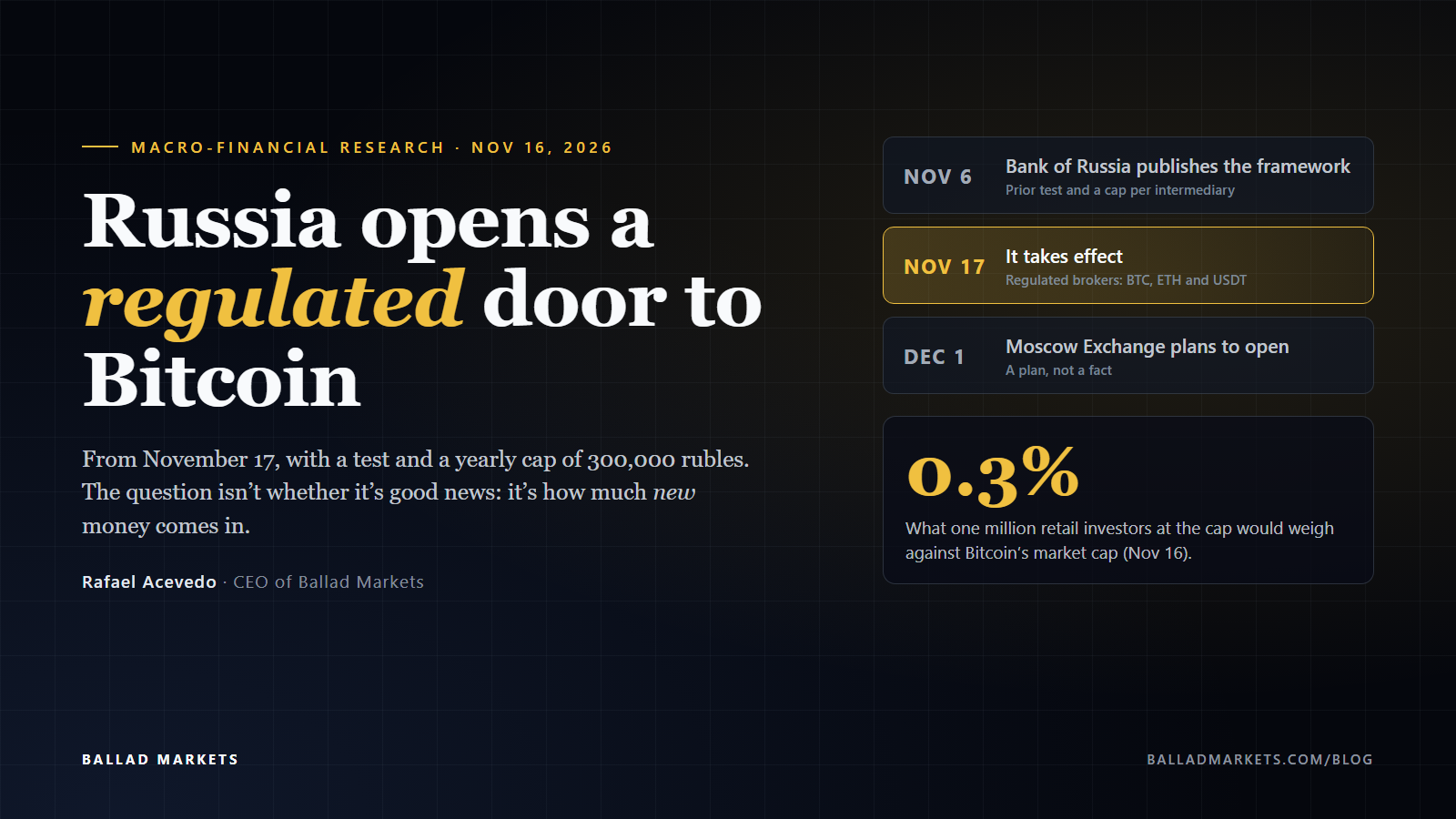
Macro-financial research · By Rafael Acevedo, CEO of Ballad Markets · November 16, 2026
From tomorrow, a Russian saver will be able to buy bitcoin through their broker, after a test and up to a yearly cap. From December 1, if the timetable holds, they will do it on the same Moscow Exchange screens where they buy Sberbank or Gazprom shares. It is the first time an economy of this size brings BTC, ETH and USDT into its regulated financial system.
For anyone who follows Bitcoin, the question isn’t whether this is good news. It’s how much new money it can really move.
The lead came from a member of our community on Instagram, after our Sunday video on Bitcoin. Thank you.
What changes, and when
| Date | What |
|---|---|
| Nov 6 | The Bank of Russia publishes the framework |
| Nov 17 | It takes effect |
| Dec 1 | The Moscow Exchange (MOEX) plans to open BTC, ETH and USDT trading |
- Non-qualified investors: must pass a knowledge-and-risk test and can buy up to 300,000 rubles a year, about $3,600 at today’s rate. The cap applies per intermediary, not per person.
- Qualified investors: no purchase cap.
- Clearing: handled by the National Clearing Centre, the same infrastructure the exchange already uses.
It does not make Bitcoin legal tender and it does not mean state purchases. It is a regulated trading channel.
The number: 4 trillion rubles
Anatoly Popov, deputy chairman of Sberbank, told TASS in August that the market could trade 4 trillion rubles in its first year: about $48 billion at today’s rate.
It needs careful reading. That is volume, not new money. Someone who buys $10,000 and later sells generates $20,000 of volume and zero net inflow. The figure also adds BTC, ETH and USDT together.
Volume is not net demand. And net demand is not price.
How much retail money fits
| Participants at the cap | Theoretical capacity |
|---|---|
| 100,000 | $360 million |
| 1 million | $3.6 billion |
| 5 million | $18.2 billion |
That is capacity, not demand. For scale: with BTC near $65,000, Bitcoin is worth about $1.3 trillion, and $3.6 billion is 0.3%.
What could really matter is qualified investors, who have no ceiling. Nobody knows today how much they will allocate. That is the number to watch.
Why price can move more than the money that comes in
Bitcoin’s price is set by the last unit traded, not by the total invested. A net purchase that is small relative to market cap can move the price a lot if it meets thin sell-side supply and shallow order books. And the reverse: if it coincides with ETF outflows or futures deleveraging, it gets diluted. Capital inflow and market-cap growth are different variables.
Russia is not discovering Bitcoin now
In December 2024, Finance Minister Anton Siluanov confirmed that Russian companies were already using bitcoin in foreign trade (Reuters). Part of what reaches regulated intermediaries will be activity that today runs through P2P or foreign exchanges and simply changes channel. Not all of it will be new money.
The risks
- Sanctions: the US sanctioned the Moscow Exchange and its clearing house in June 2024. Foreign counterparties are left out.
- Retail ceiling: 300,000 rubles a year per intermediary.
- Qualified investors: there is no data at all on how much they will invest.
- Channel switching: money that was already in crypto and is just moving.
- Timetable: December 1 is a plan, not a fact.
What we will watch
| Variable | What we look for |
|---|---|
| Volume on MOEX and at brokers | Actual activity after December 1 |
| Qualified-investor participation | Whether big capital shows up |
| Russian price premium vs the rest | Local buying pressure |
| Spot ETF flows | Whether global demand follows or diverges |
| Futures open interest | Whether the move is leveraged |
Timetable:
- November 17: the framework takes effect.
- December 1: does MOEX open?
- December: first volume and participation data.
Bottom line: follow-up, not euphoria
Russia’s move has potential structural importance: a large economy is bringing Bitcoin into its regulated infrastructure, and others may copy it. But adoption does not guarantee demand, and demand does not guarantee price.
We are not trying to guess Bitcoin from a headline. We are trying to measure whether a structural source of demand is being born.
Follow the thesis with data: open your Reader account at no cost on Ballad Markets.
Sources
- Bank of Russia, statement of November 6, 2026.
- CoinDesk, November 4, 2026: US-sanctioned Moscow Exchange to list bitcoin and Tether’s USDT in December.
- Cointelegraph: bitcoin, ether and USDT trading on the Moscow Exchange in December.
- Disruption Banking, November 13, 2026: how Russia’s new crypto exchange trading rules work.
- FinanceFeeds: the annual retail purchase cap and Sberbank and the Bank of Russia approval.
- TASS (Anatoly Popov, August 2026) and Reuters (Anton Siluanov, December 2024).
- Price and scale, read on November 16, 2026 around 03:00 UTC: BTC-USD on Coinbase ($65,088), circulating supply per blockchain.info (20.11 million BTC) and the USD/RUB rate from Yahoo Finance (82.59 rubles).
Illustrative scenarios, not forecasts. Educational content; not investment advice or a recommendation.