Crypto bots you can measure: how the Ballad Markets algorithms work
Five spot algorithms on real MEXC and Kraken data, an honesty test that tries to break them, and every bot shown next to what holding the asset would have done. Simulated results.
Bots and algorithms · Ballad Markets newsroom · November 18, 2026
Picture three in the morning in Madrid, with bitcoin falling four percent in twenty minutes. Nobody is awake to see it. A grid of orders on SOL is: it steps in at the level below, waits, and steps out at the next one when the price bounces. In the morning, the log shows what it did, what it paid in fees and, on the same screen, what would have happened if it had done nothing.
That last line is the one almost no bot platform shows, and it is the reason for this article. A trading bot is an algorithm: a set of rules that runs without getting tired or scared. It is not magic and it is not intelligence. What separates a good bot from a dangerous one is not the strategy but how honestly it is measured.
Why it matters now
Crypto markets never close. No person can watch Sunday night, which is why bots have long been the entry point to automated trading. The problem is how they are sold: with a test on the past that almost always looks good. With enough tweaking, any strategy looks like a winner in hindsight. Finance has a name for that, overfitting, and it is the most common reason a bot that “worked” stops working the day real money goes in.
We built the Ballad Markets bots the other way around: first the test that tries to break them, then the bot.
Five algorithms, all spot
The dashboard offers five strategies. All of them trade spot: no leverage and no short positions, so a bot cannot lose more than it is given.
| Algorithm | What it does | When it struggles |
|---|---|---|
| Grid | Splits capital across price levels: steps in when the price drops to a level and steps out when it rises to the next. | When the price escapes the range and does not come back. |
| DCA | Enters a fixed amount at regular intervals, can add on dips and takes profit over the average price. | In long declines without a rebound. |
| Trend | Stays in while the close is above its moving average and exits when it closes below. | In sideways markets, with many false entries and exits. |
| Dips | Enters when the price falls a set percentage from its recent high and exits at the target, the stop or the time limit. | When a dip is the start of a bigger fall. |
| Breakout | The classic “turtle” rule: enters above the N-session high and exits below the M-session low. | On false breakouts. |
Each one has three templates (conservative, balanced and active) and a manual mode: touching any number switches to manual and shows at once how the test changes.
Real exchange data, paper orders
The bots work on each exchange’s public data: the pairs, candles and order book of MEXC and Kraken, plus crypto on Alpaca. Orders are simulated for now, just like the demo account of the big platforms. The simulation charges each exchange’s real fee, different for limit and market orders, plus slippage on every side.
Inside each candle, the engine assumes the path least favorable to someone with orders on both sides: on a green candle the price visits the low first; on a red one, the high first. It is the industry-standard assumption and the one that gives the least away.
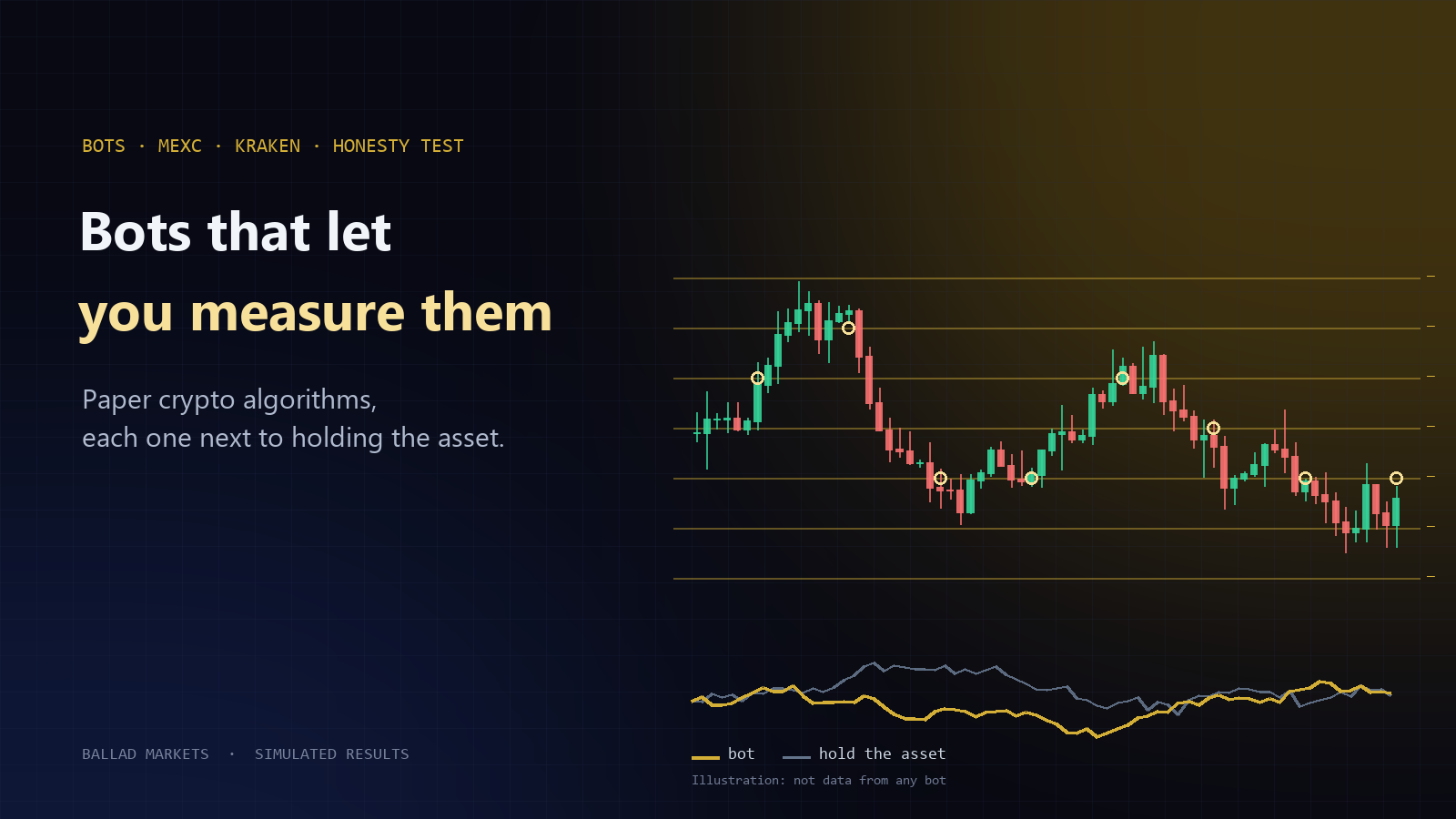
A bot that makes 3% while the asset rises 20% is not good news. That is why every bot is shown next to what doing nothing would have done.
The mandatory test and the honesty test
No bot is created without its test. Before the create button, the system simulates the setup on real candles, holds out the last 30% of the period the settings have not seen, and compares it with holding the asset. Then the honesty test tries to break the result with four questions:
- Is it luck? The deflated Sharpe ratio (Bailey and López de Prado, 2014) discounts how many setups were tried before accepting what the bot makes over holding.
- Is it fitted to the past? Combinatorially symmetric cross-validation (Bailey et al., 2017): if the best setting is chosen in one half of the period, how often does it lose to holding in the other?
- Does it break when touched? Neighboring settings are tested. A solid result is a plateau, not an isolated peak.
- What range is reasonable? Monte Carlo: the same days, in a different order, a thousand times.
The test recommends nothing and does not promise the bot will work. It says how well what already happened holds up. The verdict thresholds are our own criteria, and the screen says so.
Brakes before speed
An algorithm that trades on its own needs brakes that also work on their own. DELIA, the Ballad Markets execution engine, has a safety switch with a manual off button, a maximum daily loss, a maximum order size and an automatic shutdown after several errors in a row. Every order is idempotent: if it arrives twice, it runs once.
Live mode is built and closed. When it opens, it will trade spot on Kraken and MEXC with the user’s own keys, stored encrypted, and the server will reject any key with withdrawal permission. Ballad Markets does not hold funds: the money stays in the user’s account at their exchange. Before opening it to anyone, we are waiting for a lawyer’s written opinion on the EU Markets in Crypto-Assets Regulation (MiCA) and on Puerto Rico and U.S. rules.
Results, in the open
The house bots trade on paper and can be followed at balladmarkets.com/bots: each with its result since the day it started, its worst drawdown and, next to it, what holding the asset would have done. They are simulated results, shown as percentages, and they appear when they lose too.
The risks, no fine print
- The past does not repeat. An honest test lowers the risk of fooling yourself, but it does not predict the future.
- Grids suffer in trends. If the price leaves the range, the bot is left holding the asset at a higher price or out of a rally.
- Crypto is volatile. Double-digit drops within hours are normal.
- The exchange is a risk in itself. Outages, fee changes and delisted pairs all affect the bot.
How to try it
The bots live in the Ballad Markets dashboard, on paper, with the honesty test included. You can open a Reader account at no cost at balladmarkets.com and follow the house bots on the results page.
Simulated results. Ballad Markets is financial analysis and education software. It does not hold funds and is not a broker, exchange or investment adviser. Nothing published here is personalized investment advice. Investing involves risk of loss.
Sources: D. H. Bailey and M. López de Prado, “The Deflated Sharpe Ratio”, Journal of Portfolio Management, 2014. D. H. Bailey, J. Borwein, M. López de Prado and Q. J. Zhu, “The Probability of Backtest Overfitting”, Journal of Computational Finance, 2017. Regulation (EU) 2023/1114 on markets in crypto-assets (MiCA).