Oracle Stock and the AI Bubble: What the Credit Market Is Warning About
Oracle default insurance is at a record, above 2008, and S&P rates it one notch above junk. Why this is not the time to buy the big AI names, and how to protect yourself if you are already in.
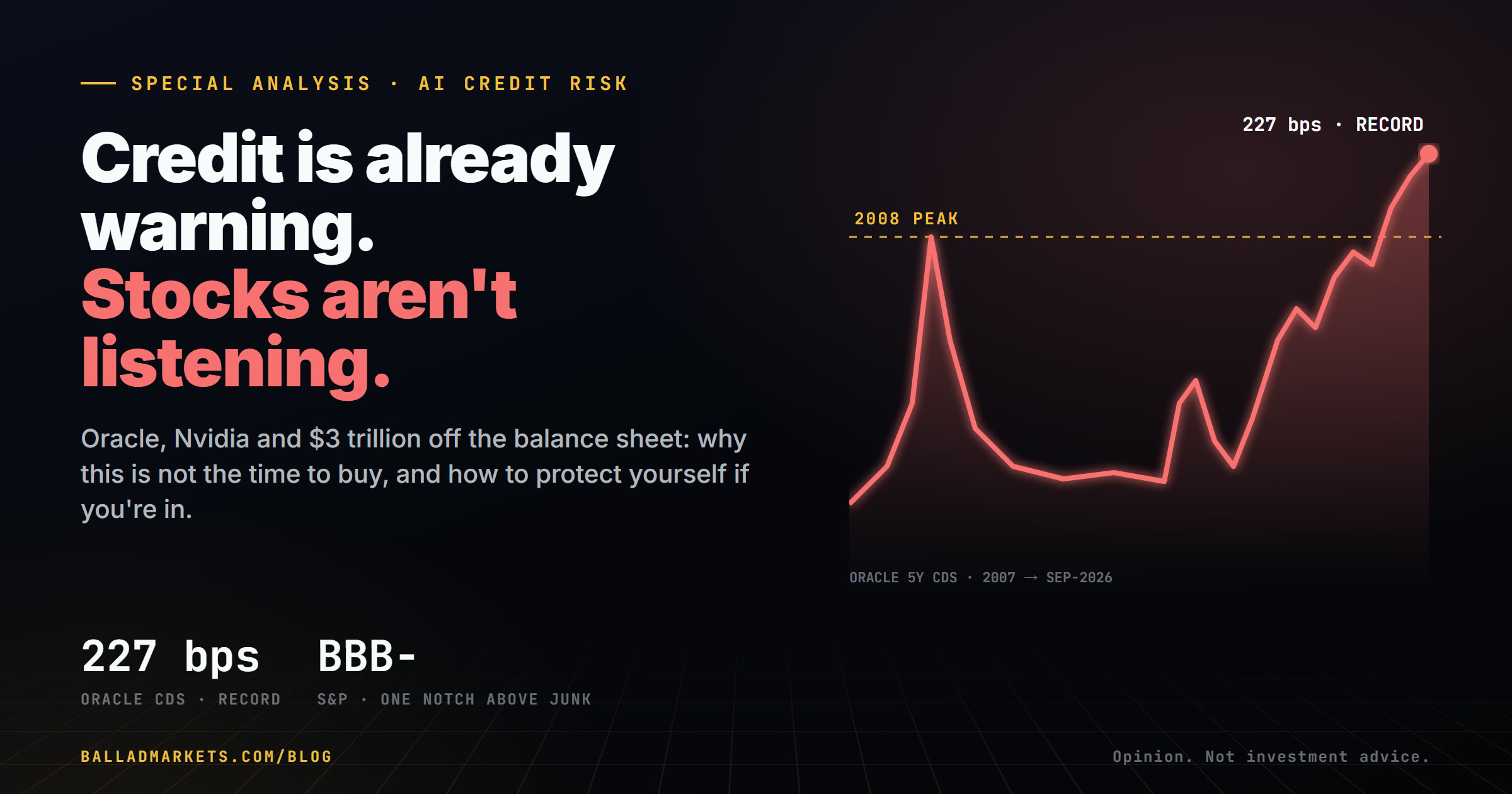
The stock market is still buying the AI story. The credit market is already questioning the numbers. And when stocks and credit tell different stories, we listen to credit.
Since August we have been warning about the same risk in the AI trade: gigantic capex, rising debt, enormous financial commitments, ever more expensive data centers, and returns on all of that investment that have yet to be proven. This analysis brings those warnings together, updates every figure to October 2026 — each one checked against its source — and explains, for beginners and veterans alike, why this is not the time to take a position in the big AI names, how to protect yourself if you are already in, and what would have to happen for that to change.
Two months that changed the credit picture
- July 9 — S&P downgrades Oracle to BBB−: one notch above junk.
- July 27 — Nvidia’s credit default swaps post their biggest jump since they started trading, on reports of AI financing deals worth up to $750 billion (talks, not signed debt).
- August 16 — The Wall Street Journal estimates that nine big tech companies carry about $3 trillion in off-balance-sheet commitments, five times their annual capex.
- September 23-24 — Oracle sends a force majeure notice on Project Jupiter, its $165 billion data-center campus for OpenAI. The stock falls about 4%. An $18 billion loan tied to the project trades at 89-91 cents on the dollar.
- September 24 — Oracle’s 2056 bond yields above 8% for the first time.
- September 25 — Oracle’s 5-year CDS hits 227 basis points, an all-time record, above its 2008 peak.
First, the basics: what is a credit default swap?
A credit default swap (CDS) is, in practice, insurance against a company defaulting. Someone who holds Oracle bonds and worries Oracle may not repay can pay a yearly premium to protect themselves. That premium is quoted in basis points: 100 basis points means paying 1% a year on the amount insured.
When the market trusts a company, insurance is cheap. When it starts to doubt, the insurance gets expensive. A CDS does not say a company will go bankrupt. It says how much it costs today to protect yourself in case it does — and that price is set by professionals with their own money on the line.
Why listen to credit? Shareholders win when things go VERY well; lenders only get paid if things go well enough to be repaid. That is why credit looks less at the dream and more at the cash: who pays, when, and with what. When stocks and credit tell the same story, there is nothing to see. When they diverge, credit tends to get there first.
Oracle stock: at the center of the storm
Oracle has bet more of its balance sheet on AI than anyone. The numbers, from Oracle’s own SEC filings unless noted:
| Indicator | Figure | Date |
|---|---|---|
| 5-year CDS | 227 bps · record, above 2008 (a year earlier: ~70-145 bps) | Sep 25, 2026 |
| Credit rating | S&P BBB− (one notch above junk) · Moody’s Baa2, negative outlook · Fitch BBB | S&P: Jul 9, 2026 |
| 2056 bond | Yield above 8% | Sep 24, 2026 |
| Total debt | $125.3 billion | Aug 31, 2026 |
| Free cash flow | −$23.7 billion over the last fiscal year, with no date for turning positive | FY2026 |
| Capex | $28.5 billion in a single quarter; guidance of $90-95 billion this fiscal year | Q1 FY2027 |
| Contract backlog (RPO) | $664 billion, roughly half of it tied to OpenAI (analyst estimate) | Aug 31, 2026 |
And Oracle stock is already telling the story. It closed at $142.30 on October 2: down 56.7% from its peak of $328.33 (September 10, 2025). It trades below its 200-day moving average ($162.89), which keeps pointing down, and its last rally died at $162.52 on September 8 without even reaching that average (then at $168.50). That is what a downtrend looks like: every rally gets sold.
An important nuance: losing investment grade usually takes two of the three agencies, and today only S&P is one notch away. UBS analysts consider a fall to junk very unlikely. But the fact that it is being seriously discussed is the news.
It is not just Oracle
- Nvidia: traded volume in its CDS rose from $640 million to $6.9 billion in six months (DTCC data cited by Bloomberg, Sep 23, 2026) — ten times more volume in default insurance on one of the largest companies in the world.
- CoreWeave, the big GPU lessor: its CDS trades above 800 basis points, junk territory.
- The sector: insuring the debt of a basket of big tech names (Amazon, Alphabet, Microsoft, Oracle) now costs close to 100 basis points, versus under 40 a year ago.
- Off the balance sheet: according to The Wall Street Journal (Aug 16, 2026), nine giants — Alphabet, Amazon, Meta, Microsoft, Oracle, Nvidia, Broadcom, SpaceX and AMD — carry about $3 trillion in commitments that do not show up as debt: data-center leases that have not started yet and multi-year purchase contracts. Not-yet-commenced leases at Alphabet, Amazon, Meta and Microsoft alone total $904 billion. The annual capex everyone watches is around $600 billion.
- Capex keeps accelerating, with more debt: Goldman Sachs puts hyperscaler capex at about $800 billion in 2026, $1.2 trillion in 2027 and $1.4 trillion in 2028, and expects more than a third of it to be debt-funded in 2027.
- Part of that capex is inflation, not capacity: UBS estimates memory (HBM, DDR, NAND) at about $923 billion of global AI capex in 2027, close to two-thirds of the total, driven by soaring memory prices. More spending does not mean more data centers — it means more expensive ones.
- The customer holding it all up: OpenAI has around $1.4 trillion in compute commitments with Oracle, Microsoft, Nvidia, Broadcom, AMD, AWS and CoreWeave. According to the Financial Times, its cumulative free cash flow from 2026 to 2030 will be −$278 billion, and its CEO has ruled out an IPO in 2026.
Is AI a bubble? Our thesis
AI itself has never been the problem. The problem is how it is being financed: with debt, cross-guarantees and circular commitments in which the supplier finances the customer that buys from it — all while projecting a gigantic need for infrastructure just as the cost of compute falls and models become more efficient.
If the cost of capital rises, capex cools. And if capex cools, the whole chain — chips, data centers, power, memory — feels it at once. The credit market is already pricing that risk; the stock market, largely, is not.
We do not know whether a sharp sell-off will come, or when. Nobody does, and anyone who claims otherwise is selling certainty that does not exist. What we do know is that today the price of these assets does not pay for the risk credit is flagging. So our position is clear: this is not the time to take a position in the big AI names.
The bull case (and why we take it seriously)
Serious analysis presents the other side. Oracle’s backlog is real and growing; its cloud infrastructure revenue doubled in a year; demand for compute still outstrips supply; and the rating agencies other than S&P still leave room. If OpenAI and other AI customers pay what they signed and free cash flow turns positive, this analysis will have been too cautious. We accept that: we would rather be late to a rally than early to a crash.
Already in and underwater? How to protect yourself
General education, not personal advice: every situation is different.
- Measure your real exposure. Add what you hold in these names AND in the funds that hold them: a tech fund or an S&P 500 fund is already heavily weighted toward them. Many people are more exposed than they think.
- Decide the size, not the forecast. The useful question is not “will it fall?” but “if it drops another leg, can I hold without selling at the worst moment?” If the answer is no, the position is too big.
- Do not average down on hope. Buying more because it fell only makes sense with a plan written in advance — levels and sizes decided calmly — not to “get back to even”.
- Write down what would make you exit. A price, a data point (a second rating downgrade, a guidance cut) or a time limit. Deciding in advance avoids deciding in fear.
- Diversify for real. Ten tech stocks are not ten bets: they are one bet repeated ten times.
- Know the hedges, even if you don’t use them. Reducing size, holding cash or, for those who know how, protective options. Hedging costs money: it is insurance, not an investment.
When to buy: the conditions we are waiting for
These big names can be bought. Not now. We will announce it when signals like these appear:
- CDS stop rising and fall in a sustained way: credit calms down;
- companies rationalize capex without crushing growth;
- free cash flow turns positive where it is burning today;
- big AI customers prove they can pay what they signed;
- prices correct enough to pay for the risk, and the trend turns — for Oracle, reclaiming and turning up its 200-day moving average.
A swing trade is not an investment. A trade of days or weeks, with its own stop and rules — like the ones our CHESKO desk executes — can make sense even when the multi-year investment view is “not yet”. They are different horizons with different risks, and they should not be mixed.
Want to know when those conditions arrive? Subscribe below: when we publish the signal, you will get it by email first.
Disclosure. This is an opinion piece by Ballad Markets, published on October 4, 2026, with data up to that date. Its authors do not recommend taking a position today in the securities mentioned. The CHESKO 2.0 desk operates with its own horizons and rules, independent of this view.
For information and education only. Not financial advice or a personal investment recommendation. Investing involves risk of loss, including loss of principal.
Sources:
Oracle 10-Q (SEC) ·
Q1 FY2027 results (SEC) ·
S&P downgrade ·
Oracle CDS at a record ·
2056 bond ·
Project Jupiter ·
Nvidia CDS (Bloomberg) ·
WSJ: $3 trillion off balance sheet ·
Goldman Sachs: capex and debt ·
UBS: memory in AI capex ·
FT via Benzinga: OpenAI cash burn ·
Sector CDS.
Versión en español: La burbuja de la IA vista desde el crédito.