None of this should surprise you: the timeline of the AI bubble on trial
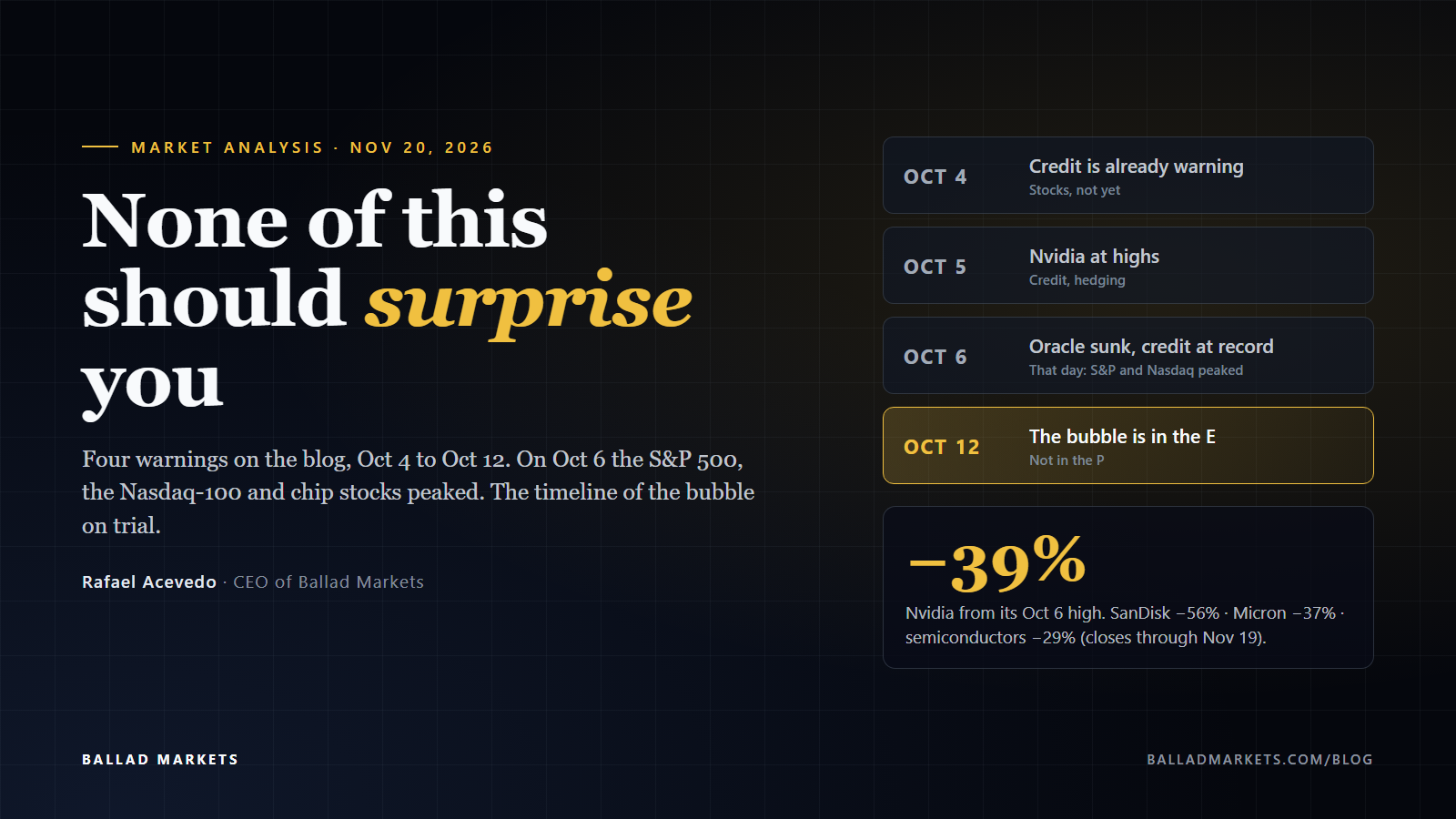
Four warnings on the blog, Oct 4 to Oct 12: credit was warning, Nvidia was at highs, Oracle at lows and the bubble was in the E. On Oct 6 the S&P 500, the Nasdaq-100 and chip stocks peaked. What happened next, stock by stock, and the AMD exception.
Market analysis · By Rafael Acevedo, CEO of Ballad Markets · November 20, 2026
A few weeks ago, at a family celebration, the conversation ended up where almost every conversation ends up these days: artificial intelligence. Around the table were people who work at big tech companies (I won’t say which), and when memory and cloud stocks came up, the answer was unanimous: “That’s going to keep going up.” They gave me price targets with the confidence of a Morgan Stanley note. And right then a scene from The Big Short came to mind: someone on the phone who, tired of the hedging, asks the other person to say the word out loud. Bubble.
I didn’t say it at the table. I had already written it, with a date, on this blog. What has happened since fits in four articles and six weeks of prices. This is that timeline. Not to boast, but for what it teaches: nothing happening today should surprise anyone who read those warnings. And on social media we had been saying it for weeks before.
October 4: credit is already warning; stocks, not yet
The first warning was “Oracle Stock and the AI Bubble: What the Credit Market Is Warning About.” The thesis fit in one line: when stocks and credit tell different stories, listen to credit. Oracle’s five-year default insurance had hit 227 basis points, above its 2008 peak, and S&P rated it one notch above junk. Nvidia’s credit default swaps had just seen their biggest jump since they started trading. Our conclusion was blunt: this was not the time to get into the big AI names.
October 5: the stock at highs, credit hedging
The next day we published our Nvidia page. The stock was less than 1% from its all-time high, the company was worth about $5.6 trillion and the business was posting the best quarter in its history. Even so, we wrote that it was not the time to open a long-term position, because Nvidia was getting ever more involved in financing the very boom that feeds it.
October 6: the stock sunk, credit at a record
That Monday we published our Oracle page: 57% below its record, with its default insurance at highs. It was the company where the way AI was being financed showed most clearly. That same day, October 6, the S&P 500, the Nasdaq-100, the semiconductor index, Nvidia and AMD all peaked. We didn’t know it then. We know it now.
October 12: the bubble is in the E, not the P
The fourth article, “The AI bubble is in the E,” moved from credit to earnings. Many AI stocks did not look expensive on expected earnings, the E in the P/E ratio. The problem is that those earnings depended on a spending cycle that finances itself: suppliers who are also customers, investors and lenders. If the E gets revised, whoever thought they bought cheap finds out they never did. A whiteboard example: a $100 stock with $5 of expected earnings trades at 20 times; if the forecast drops to $3, it has to fall to $60 to get back to 20 times, without anyone having “overpaid” by the previous day’s math.
“The bubble isn’t in the P. It’s in the E.”
Ballad Markets, October 12, 2026
What happened next
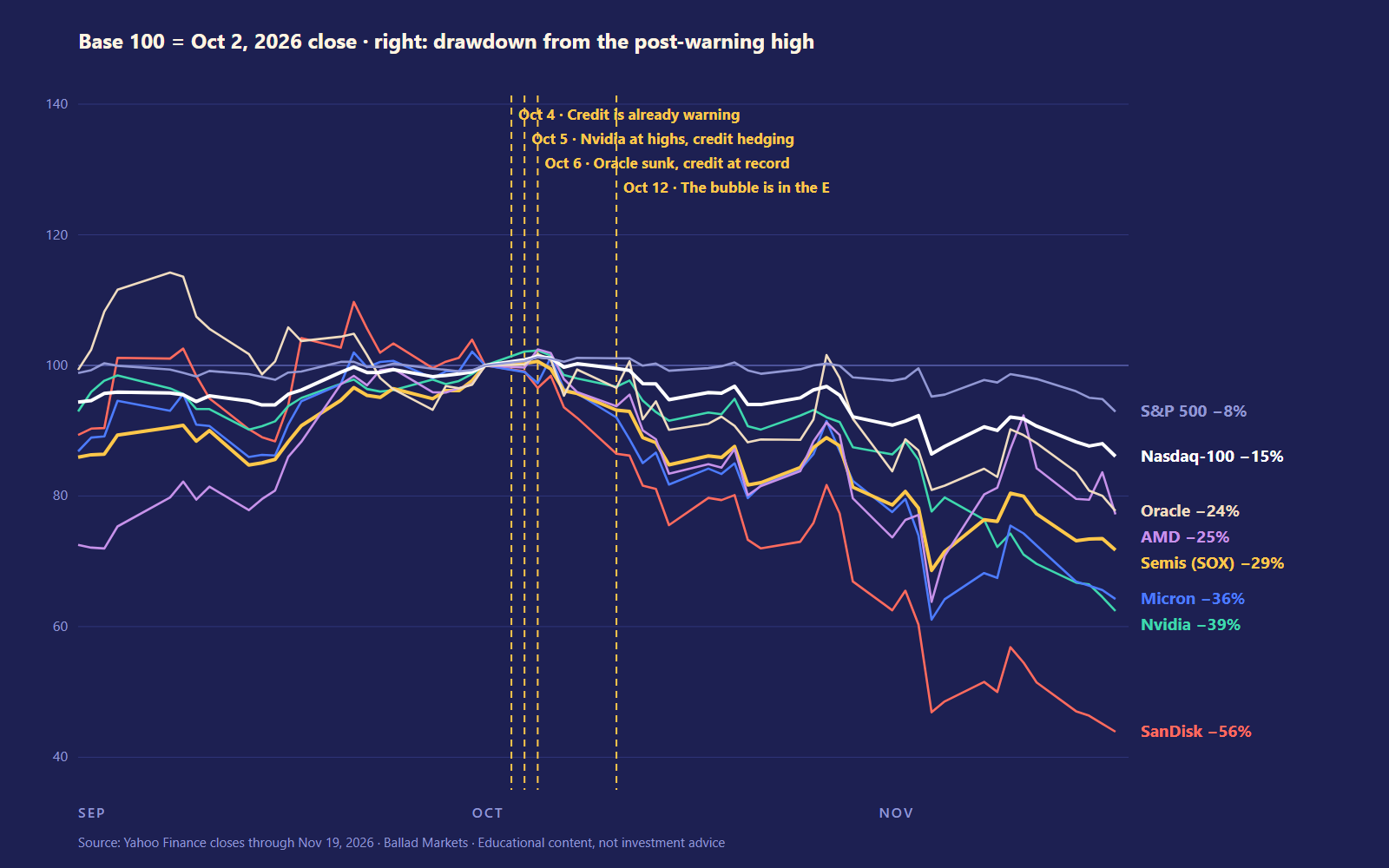
From the October 2 close, the last one before the first warning, to November 19:
- SanDisk: −56%. Memory fell first and fell hardest.
- Nvidia: −38%; −39% from its October 6 high.
- Micron: −36%; it peaked on October 7 and is down 37% from there.
- Semiconductors (SOX): −28%.
- AMD: −23%.
- Oracle: −22%, on a stock already 57% down.
- Nasdaq-100: −14%. S&P 500: −7%, and −8.2% from its October 6 high.
The pattern is a bubble deflating from the outside in: memory first, the most cyclical part; then chips; and finally the broad index. At Ballad Markets we call it the bubble on trial: the S&P 500’s third decline in two years, after the 2025 tariff scare and the 2026 Iran war, and the first with no outside trigger. This time the market is asking itself whether AI spending pays for what it costs.
The exception I didn’t see coming: AMD
I thought AMD would follow the same path as Nvidia, and it didn’t, not entirely. It fell, but less, and its sharpest hit was of a different kind. On November 19 it lost 7.7% in a day after Hunterbrook, an outlet linked to short sellers, published a report on its China exposure and export controls. The report itself says its findings do not on their own establish a violation, and AMD says it complies with the law and that the report misrepresents its practices. Add the new export licenses the Commerce Department just required for several Southeast Asian countries.
My read: AMD’s problem today is political and regulatory, not the company’s health or technology. I remain positive on it. But I label it as what it is, an opinion, with its risk: regulatory fights can last longer than an investor’s patience.
What this timeline teaches
- Credit spoke first. Oracle’s and Nvidia’s default insurance moved weeks before the stocks did.
- The top came with the best news. Nvidia was posting its best quarter when it peaked. Bubbles don’t pop on bad news; they pop when good news stops being enough.
- Insiders are often the last to see it. Not for lack of intelligence, but because their wealth is on the line. Listen to those who pay to protect themselves, not to those who are already invested.
- Not everything that falls is the same. Telling a business problem from a political one, as with AMD, is what separates a risk from an opportunity.
What now?
The thesis playing out doesn’t mean front-running the bottom. On the S&P 500 we keep a live map of the zone we watch, the 6,832 to 7,016 box, and the condition for it: a sweep, a reclaim and calm, with the VIX below 18. We explain it in “The S&P 500 map: a box, not a date.” With a free Reader account you see the live map and can set an alert.
Sources
Prices: Yahoo Finance, daily closes from October 2 to November 19, 2026 (MU, SNDK, ORCL, NVDA, AMD, ^NDX, ^SOX, ^GSPC). Warnings: Ballad Markets articles of October 4, 5, 6 and 12, 2026, with their sources. AMD: CNBC, Nov 19; Forbes, Nov 20; Benzinga. The scene referenced is from the film The Big Short (2015).
A scenario, not a prediction. Educational and informational content: not investment advice or a personalized recommendation. Past performance does not guarantee future results.